
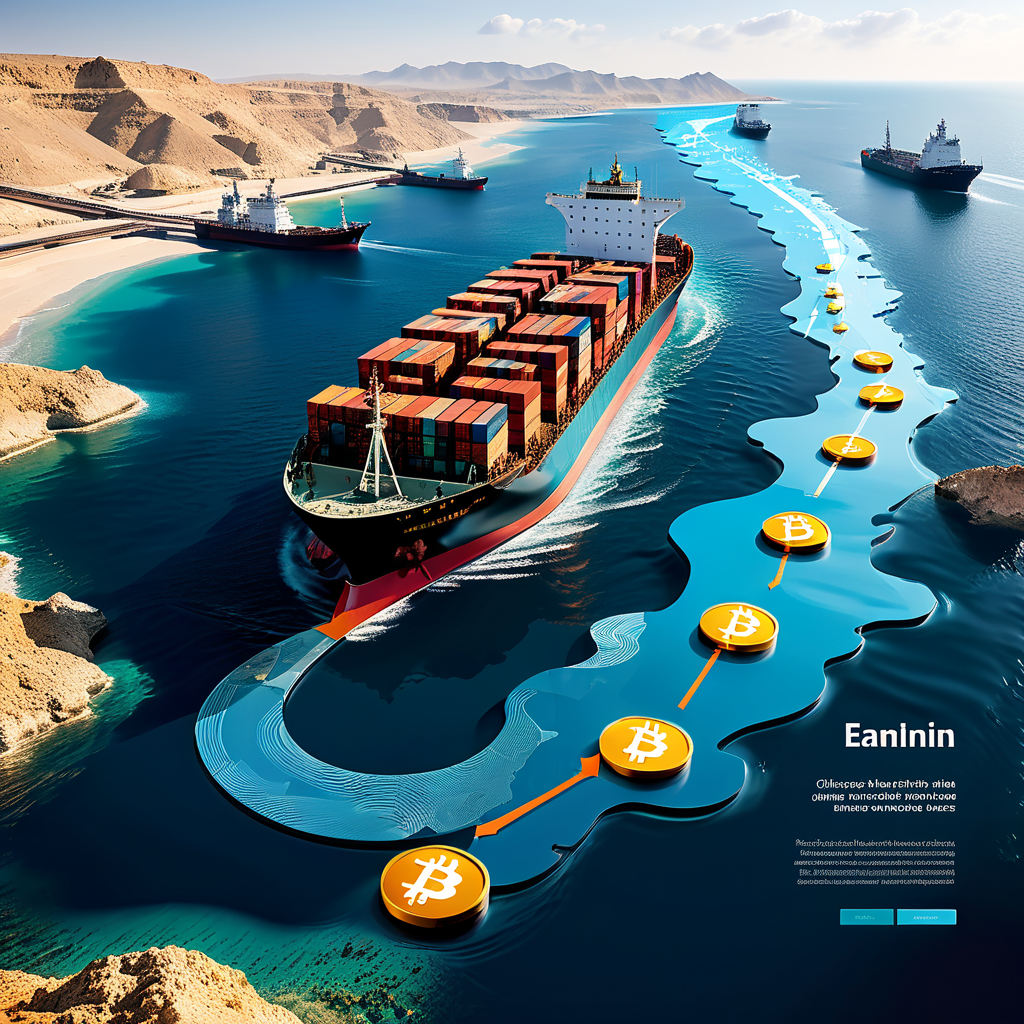
According to reports from the Financial Times, Iran aims to impose a Bitcoin-denominated fee on oil tankers navigating the Strait of Hormuz. This move suggests an innovative application of cryptocurrency as part of sanctions-resistant trade mechanisms.
The initiative places Bitcoin within a strategically vital maritime corridor, intersecting settlement speed, sanctions exposure, and geopolitical leverage. The potential implications are significant, affecting oil distribution, shipping expenses, compliance with sanctions, and the pricing of geopolitical risks if Hormuz transit becomes contingent on digital payments.
Hamid Hosseini, spokesperson for Iran’s Oil, Gas and Petrochemical Products Exporters’ Union, indicated that tankers must submit cargo details via email to receive a tariff assessment. Payment in Bitcoin would then be required within seconds to ensure anonymity due to sanctions, as per the report.
The proposed tariff stands at $1 per barrel, with empty vessels granted free passage. Additionally, ships traversing the Gulf have reportedly been warned that unauthorized transit attempts could lead to destruction.
Iran’s objective appears straightforward: leverage control over a critical maritime chokepoint into a settlement system beyond traditional dollar clearing and sanctions enforcement. Yet questions remain on Bitcoin’s long-term viability for such purposes or whether initial claims might evolve into a more complex crypto infrastructure involving brokers, OTC desks, or stablecoin conversion.
This development arises amidst an unstable ceasefire, with Hormuz passage still contested and throughput hindered. The Associated Press describes the ceasefire terms as disputed, while the Financial Times suggests Iran seeks to establish a secure transit protocol in coordination with its armed forces.
Within this context, Bitcoin serves more as a functional tool than a symbolic gesture at the intersection of legal uncertainty and commercial urgency.
The Strait of Hormuz is pivotal, handling approximately 20% of global petroleum liquid consumption. The International Energy Agency reports around 20 million barrels per day transit through it in 2025. UNCTAD notes it carries about a quarter of global seaborne oil trade, along with significant LNG and fertilizer flows.
The proposed $1 per barrel toll offers a direct economic measure. For instance, a large tanker carrying 2 million barrels would incur a $2 million fee—considered justifiable if it facilitates trapped inventory movement through a bottlenecked corridor.
Kpler data cited by the Financial Times indicates 175 million barrels loaded onto 187 tankers in the Gulf, with industry executives estimating 300 to 400 ships awaiting safe passage. EOS Risk reports only 10 to 15 ships can currently transit daily compared to about 135 before conflicts intensified, highlighting significant throughput compression.
Alternative pipeline routes are limited, with the IEA estimating only 3.5-5.5 million barrels per day can bypass Hormuz under current conditions. This dependency underscores Iran’s leverage in dictating maritime passage terms.
Iran seeks a transition from informal wartime control to a structured protocol requiring prior disclosure and payment compliance for transit. Bitcoin aligns with this framework, enabling transactions without correspondent bank involvement—a significant advantage given banks would likely reject sanctioned transactions.
Despite the practical appeal of Bitcoin in reducing banking friction, its traceability remains an issue due to public ledger visibility. The concern for sanctioned entities lies more in transaction completion and intermediary risk assumption than anonymity.
Chainalysis’ 2026 sanctions report reveals substantial blockchain-based financial activity involving Iran-linked addresses, highlighting both the scale and scrutiny faced by such transactions.
Thus, while Bitcoin’s utility as a Hormuz toll payment rail is plausible due to urgency and fragmented counterparties, its invisibility remains debatable. The real test will be whether this system can integrate into mainstream shipping operations without scaling issues.